
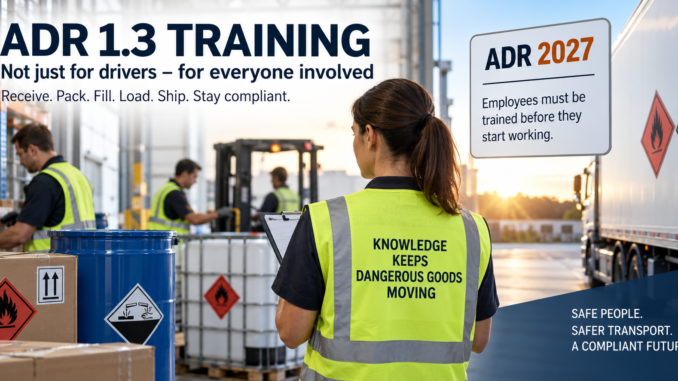
Thousands of companies across Europe receive, dispatch, pack, load, unload or fill dangerous goods every day. Dangerous goods are not limited to specialist chemical companies. Paints, aerosols, cleaning chemicals, adhesives, fuels, gases, lithium batteries, corrosive products and many other common industrial products may fall within the scope of ADR.
Yet there is still a significant gap between what happens in daily operations and what ADR actually requires. In many warehouses, production plants, distribution centres and logistics companies, employees work with dangerous goods without having received adequate ADR awareness training. Some organisations assume that ADR training is only relevant for truck drivers. Others believe that employees only need training when large quantities of dangerous goods are transported.
Both assumptions can create serious compliance problems.
Chapter 1.3 of ADR places training obligations on people whose duties relate to the carriage of dangerous goods. ADR 2025 already requires employees to be trained according to their responsibilities before assuming those responsibilities. Until the required training has been provided, they may only perform those functions under the direct supervision of a trained person.
With ADR 2027, the wording is being broadened further. This makes 2026 an important year for companies to review who within their organisation is actually involved in dangerous goods activities.
ADR Is About More Than the Driver
When companies think about ADR training, they often immediately think about the driver carrying an ADR certificate. Driver training under Chapter 8.2 is certainly an important part of the ADR system, but it is only one part.
Many people influence the safety and compliance of a dangerous goods shipment long before the vehicle leaves the site.
A warehouse employee may select packages and prepare them for shipment. Another employee may apply hazard labels or Limited Quantity marks. A shipping department may prepare the transport document. A forklift operator may load the packages into a vehicle. Production employees may fill drums, IBCs or tanks. Goods-receiving personnel may unload incoming dangerous goods, while supervisors may be responsible for checking that procedures are followed.
ADR recognises these different responsibilities. Chapter 1.4 identifies participants such as the consignor, carrier, consignee, loader, packer, filler and unloader. Employees carrying out activities on behalf of these participants can therefore have responsibilities under ADR even if the words “dangerous goods” do not appear in their official job title.
This is precisely where many companies underestimate their training obligations.
An employee does not have to be a Dangerous Goods Safety Adviser or an ADR-certified driver to require dangerous goods training.
What ADR 1.3 Actually Requires
ADR 1.3 training is intended to provide employees with knowledge appropriate to their duties and responsibilities. It is therefore not simply a generic presentation explaining that dangerous goods can be hazardous.
The training consists of several elements. Personnel must receive general awareness training so that they understand the general requirements governing the carriage of dangerous goods. They must also receive function-specific training relating directly to their actual tasks and responsibilities. In addition, safety training must address the hazards and risks presented by dangerous goods, including safe handling and what to do in the event of an incident. Security requirements under Chapter 1.10 must also be addressed where applicable.
This means that the content required for someone preparing transport documentation may differ from the content needed by an employee filling IBCs or loading pallets onto a vehicle.
Good ADR Awareness 1.3 training therefore connects the regulations with daily operations. Employees should understand why UN numbers matter, what hazard labels mean, how dangerous goods are identified, what packaging and marking requirements may apply and why damaged or incorrectly labelled packages can create a transport risk.
They should also understand their own role in the compliance chain.
ADR 2027 Broadens the Scope
An important amendment proposed for ADR 2027 concerns the wording of Chapter 1.3.
ADR 2025 currently begins by referring to “persons employed by the participants” listed in Chapter 1.4. For ADR 2027, this wording is changed to “persons participating in the activities referred to in Chapter 1.4”. The word “Employees” in the following sentence is consequently replaced by “They”. The amendments also clarify that references to “personnel” include each person performing an equivalent role or function.
This may look like a relatively small editorial change, but its practical meaning is important.
The training requirement should not depend simply on whether somebody is formally employed by the company. Self-employed workers, contractors or other persons performing equivalent dangerous goods functions can also fall within the scope. The official Swiss explanatory document for the ADR 2027 amendments specifically notes that the wording has been adapted so that the term “persons” also covers people without an employer or people working on their own account.
ADR 2027 also extends the record-keeping wording accordingly. Training records are not an administrative detail that companies should deal with only after an inspection. They form part of demonstrating that the organisation has identified the people performing dangerous goods activities and has provided appropriate training.
Start your ADR Awareness 1.3 online training
The Requirement to Train Before Independent Work Already Exists
One point deserves particular attention because it is frequently misunderstood.
Companies should not wait for ADR 2027 before addressing untrained personnel.
ADR 2025 already states that employees must receive the required training before assuming their responsibilities. Where the required training has not yet been provided, they may only perform those functions under the direct supervision of a trained person.
In practice, this can be very different from what happens in many warehouses.
A new warehouse employee may start picking and loading dangerous goods immediately. Temporary staff may receive a short general safety induction but nothing specifically relating to ADR. Someone in customer service may suddenly be asked to prepare dangerous goods transport documents because a colleague is absent. Production employees may begin filling dangerous goods into packaging after only being shown how to operate the filling equipment.
None of these situations automatically satisfies ADR 1.3.
The important question is not whether an employee has worked for the company for one day or ten years. The question is whether that person has received training appropriate to the dangerous goods responsibilities they are actually performing.
Limited Quantities Do Not Mean Limited Responsibility
Another common source of misunderstanding involves Limited Quantities.
Many companies transport paints, aerosols, adhesives, chemicals and other products under the Limited Quantity provisions and conclude that ADR training is therefore unnecessary. Exemptions may remove or modify certain transport requirements, but they should never be interpreted as a general exemption from competence.
The same problem occurs with companies that only occasionally ship dangerous goods. Frequency is not the determining factor. An employee preparing one dangerous goods shipment per month can make exactly the same classification, packaging, marking or documentation error as someone preparing twenty shipments every day.
In fact, employees who only occasionally handle dangerous goods may present an increased risk because the procedures are less familiar to them.
Training provides the background that allows employees to recognise when something is wrong rather than simply following a checklist without understanding it.
Companies Should Act Before ADR 2027
The ADR 2027 amendments have been adopted by the UNECE Working Party and notified through the formal ADR amendment procedure with an intended entry into force date of 1 January 2027. Companies involved in dangerous goods should therefore use the remaining preparation period to review their training systems.
The first step is to identify everyone involved in receiving, consigning, packing, filling, loading, unloading, documenting or otherwise preparing dangerous goods for road transport. Their actual tasks should then be compared with the training they have received.
Companies should also check whether training records exist, whether the content remains appropriate to current responsibilities and whether refresher training is necessary following changes in legislation, products, procedures or job functions.
ADR Awareness 1.3 should not be treated as an optional extra for specialist dangerous goods personnel. For many warehouse, logistics, production, shipping and receiving employees, it is part of the basic competence required to perform their work safely and compliantly.
The arrival of ADR 2027 is therefore a good reason to review training, but companies should not misunderstand the message: the obligation did not suddenly appear in 2027.
For many organisations, the real issue is that the obligation has been there for years — but the training has not.
Start your ADR Awareness 1.3 online training